
The lights dimmed over the ice at Art on Ice, and a hush drifted through the arena in Zurich. Nearly ten thousand people sat wrapped in that fragile stillness that exists just before something begins. The ice looked almost silver beneath the lights. And then, from the edge of the rink, Ilia Malinin stepped forward.
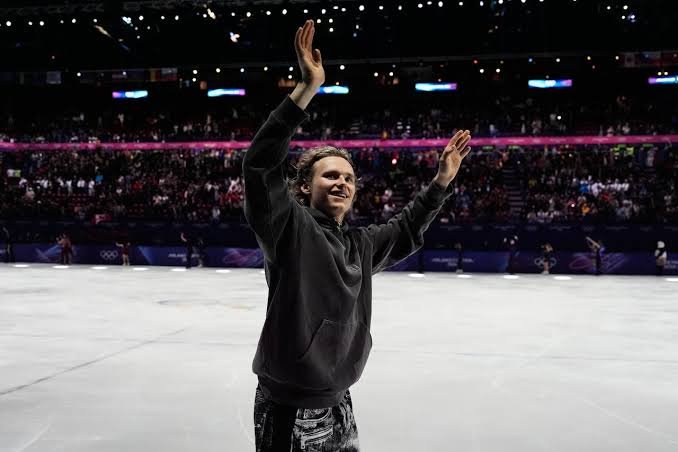
For a moment, he didn’t move.
The music from James Bay rose softly through the arena, carried by the cool air above the ice. Somewhere in the darkness, Jess Glynne’s voice floated over the crowd, warm and bright against the quiet. Malinin lowered his head slightly, as if listening to something deeper than the music.
Then he pushed off.
The first glide was effortless, almost weightless. His blades whispered against the ice, carving pale lines that caught the light like threads of glass. From the stands, people leaned forward without realizing it. There was something in the way he moved — not urgency, not showmanship, but a kind of quiet resolve.
He gathered speed slowly, the way a storm gathers strength far out at sea. His shoulders squared. His breathing became visible in the rhythm of his body. The ice reflected his silhouette as if the rink itself were holding its breath.
When he rose into the quadruple axel, the moment seemed to stretch.
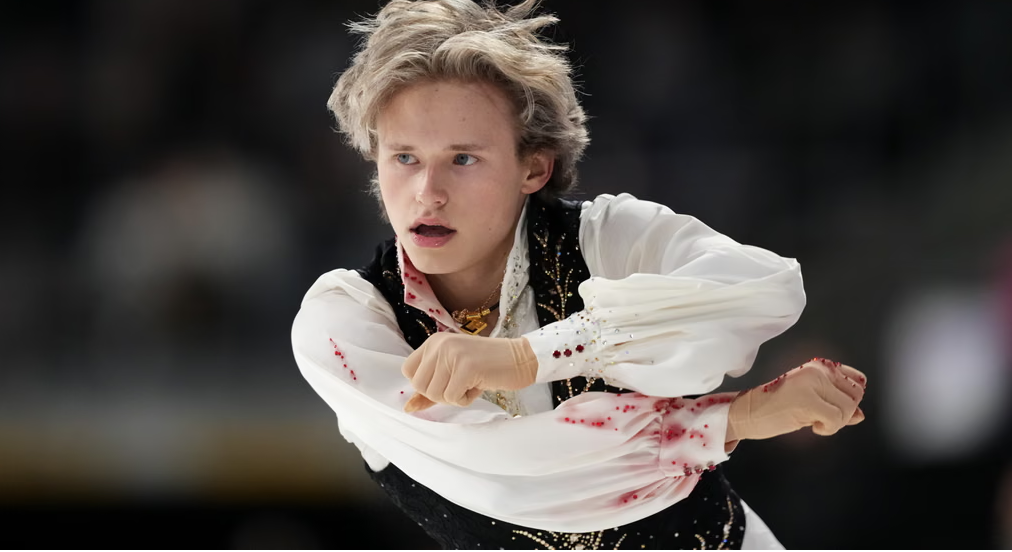
The jump unfolded in silence — a clean lift, a body suspended between gravity and defiance. For an instant he hung there, rotating through space with that impossible calm that only the very best skaters possess. The landing came with a soft, decisive scratch of steel on ice, so smooth it almost felt unreal.
A ripple passed through the arena.
But before the applause could fully form, Malinin’s momentum carried him onward. His arms cut through the air, his edges tightening into sharper curves. Then, in a movement so sudden it felt like a spark, he launched into a backflip — the arc quick, precise, fearless — before touching down again with effortless control.
The crowd erupted, yet the sound arrived almost late, like thunder following lightning. People were already on their feet, hands over mouths, laughter mixing with disbelief. The ice beneath him shimmered under the arena lights as if it too had felt the impact of the moment.
Only days earlier, disappointment had hung heavy around his name after the Olympic stage had slipped from beneath him. Yet here, in this glowing arena far from that memory, none of that weight seemed visible. What remained was something quieter, fiercer — the kind of determination that doesn’t speak, only moves.
As the music faded, Malinin slowed to a gentle glide.
He lifted his head toward the lights, chest rising with one deep breath. Around him the applause continued, loud and unending, but on the ice he seemed almost alone — a solitary figure standing inside the echo of what had just happened.
And long after the arena emptied that night in Zurich, people would remember the feeling more than the jump.
Not the roar of the crowd, not even the impossible flight through the air.
But the stillness before it.
And the fire that followed.