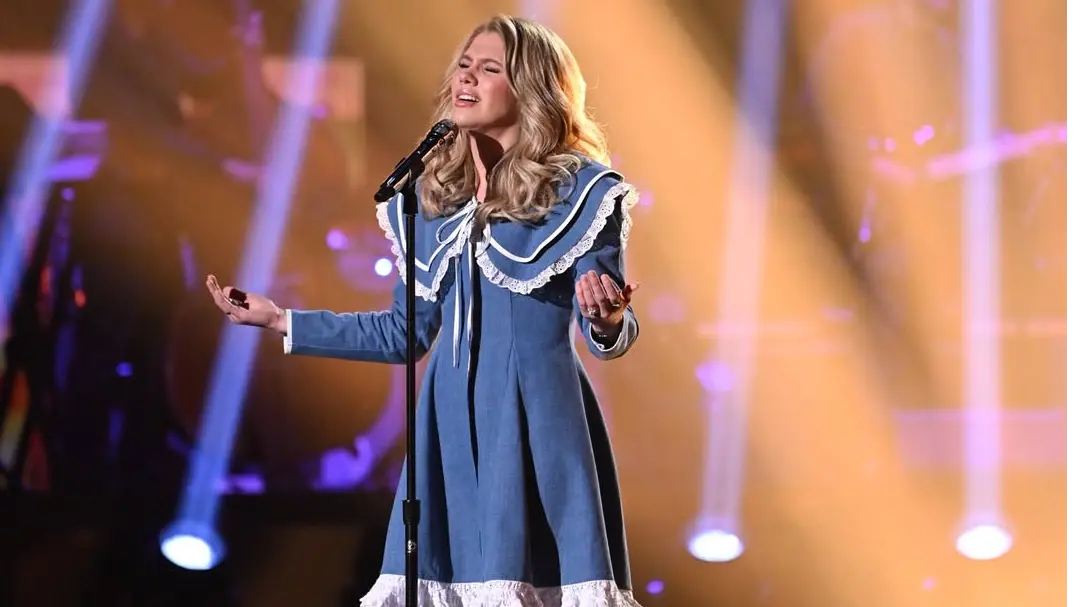
There are performances that impress, and then there are performances that reveal. On American Idol, Hannah Harper delivered something that felt less like a competition piece and more like a quiet confession unfolding in real time. It wasn’t loud in intention—but it was undeniable in impact.

“Heads Carolina, Tails California” is not just a song—it’s a choice. A coin flip between two directions, two lives, two versions of yourself. And somehow, standing under the lights of a Top 12 live show, Hannah made it feel like she wasn’t flipping anything at all. She already knew where she stood.
What made this moment different wasn’t the song itself—it was the shift in how she carried it. The uptempo arrangement brought energy, yes, but it never overpowered her identity. Instead, it sharpened it. Every movement, every note, every breath felt grounded in something real—something she didn’t need to prove anymore.
There’s a subtle power in returning to where it all began. When Hannah first sang this song during her audition, it introduced her voice to the world. But now, revisiting it wasn’t about nostalgia—it was about perspective. The same melody, but a different woman standing inside it.
And that’s where the performance quietly transformed.
Because growth on a stage like this is usually measured in vocal runs, range, and control. But Hannah’s evolution didn’t scream—it settled. It became more precise, more intentional, more honest. She wasn’t trying to impress anymore; she was allowing people to understand her.

That distinction changes everything.
From the judges’ panel, Carrie Underwood watched with a kind of pride that felt almost reflective. It wasn’t just approval—it was recognition. The kind that says, “You’re starting to see it now.” And yet, even in that pride, there was a reminder. A piece of advice she had given before, now returning with more weight.
Because advice hits differently when you’re ready to hear it.
What Carrie has consistently pointed toward isn’t perfection—it’s presence. The ability to stay inside a performance without letting the pressure of the moment pull you out of it. And in this performance, Hannah came closer than ever to mastering that balance.
But not entirely.
And that’s what makes it compelling.
There were fleeting seconds—barely noticeable to the casual viewer—where you could feel the edge of hesitation. Not enough to break the performance, but enough to remind you that she’s still in the process of becoming. Still refining the space between instinct and control.
Yet maybe that’s the point.
Because the most powerful artists aren’t the ones who eliminate vulnerability—they’re the ones who carry it without letting it consume them. Hannah didn’t hide her edges; she softened into them. And in doing so, she created a performance that felt human rather than polished.
And audiences remember human.
What makes this moment linger isn’t the question of whether it was her best performance ever. It’s the realization that she’s no longer performing to become something—she’s performing as someone who already is. That shift, though subtle, changes the trajectory entirely.
Now, every song she touches carries more than just sound—it carries identity.
And identity travels further than technique ever will.
So was this her best performance?
Maybe that’s the wrong question.
Because what Hannah Harper delivered wasn’t a peak—it was a turning point. A quiet, steady alignment between who she was when she first walked in and who she’s becoming now.
And if this is what her “return to roots” looks like, then what happens when she decides to leave them behind…?