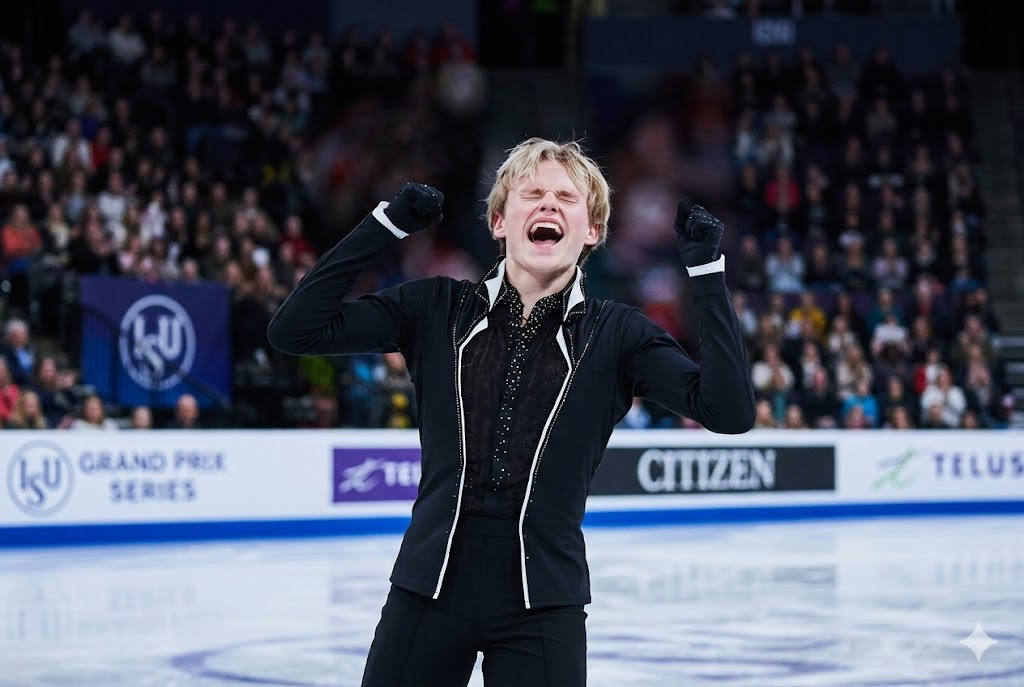
There are moments in sport when time seems to hesitate—when the body does something so precise, so improbable, that it almost feels like reality pauses to watch. In those moments, you’re not just witnessing performance… you’re witnessing possibility being rewritten.
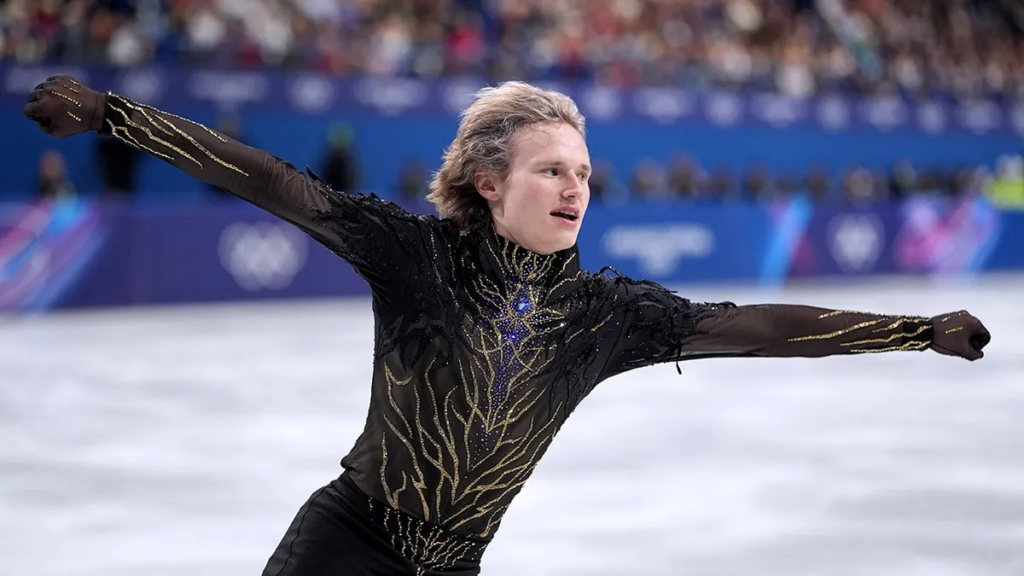
That’s where Ilia Malinin exists right now.
When he steps onto the ice, it doesn’t feel like preparation—it feels like calibration. Every movement carries intention. Every edge is measured. And when he launches into the air, it’s not chaos or instinct taking over—it’s something closer to design. The rotation is too clean, too efficient, too controlled to feel accidental.
It makes you wonder: is this still artistry shaped by training… or something closer to engineering?
Figure skating has always lived at the intersection of physics and feeling. Blades cut through ice with friction and force, bodies spin within strict limits of momentum and balance, and gravity remains the final judge no one can negotiate with. For decades, skaters learned how to exist within those boundaries—pushing them, yes, but never quite bending them.
Until now.
Because what Malinin does in the air doesn’t look like he’s surviving physics—it looks like he’s negotiating with it. His jumps don’t just reach height; they create time. His rotations don’t rush; they unfold with an almost mechanical clarity, as if every fraction of a second has been mapped before his feet ever leave the ice.
It’s not just difficult—it’s deliberate.
And that distinction changes everything.
When most athletes attempt the impossible, there’s a visible strain—a moment where risk becomes visible, where the body fights against its own limits. But with him, that tension often disappears. The takeoff is clean. The air position is exact. The landing feels pre-decided, not recovered.

It doesn’t look like defiance.
It looks like control.
But control, at this level, raises an uncomfortable question for the sport itself: if jumps can be perfected to this degree, what happens to unpredictability? What happens to the fragile beauty that once came from not knowing whether a skater would make it through a program untouched?
Because perfection, when it becomes routine, begins to shift the meaning of greatness.
The crowd still gasps—but differently now. Not out of shock, but out of expectation fulfilled. And that’s a dangerous place for any art form to live, where awe slowly becomes assumption.
Yet, beneath all of this precision, something else is quietly forming.
Because even in the most engineered jump, there’s a human at the center of it. A heartbeat that can’t be calculated. A moment of stillness before takeoff that isn’t physics—it’s presence. And lately, if you watch closely, you can see glimpses of that side of him beginning to surface.
A glance that lingers a second longer. A movement that stretches beyond necessity. A performance that starts to breathe instead of just execute.
And that’s where the story begins to deepen.
Because maybe the real question isn’t whether he’s rewriting physics.
Maybe it’s what he’ll choose to do once he no longer has to.
When the hardest jump in history becomes just another element… when the limits he shattered become the limits everyone else trains toward… when engineering no longer separates him from the field—what remains?
That answer won’t be found in the air.
It will be found in what happens before the jump… and after the landing.
Because the future of figure skating won’t belong to the one who defies physics the most—it will belong to the one who makes people forget physics was ever part of it at all.
And if that’s where this is heading, then what we’re watching right now isn’t the peak.
It’s the blueprint.