
There are athletes who rise through the ranks—and then there are those who quietly rewrite what the ranks even mean. Ilia Malinin belongs to the latter. When you trace his journey from 2016 to 2026, it doesn’t feel like a decade of growth. It feels like watching a spark evolve into something almost untouchable—something that doesn’t just compete, but transforms the very language of figure skating.

In 2016, he was just a boy on the ice. The edges were there, the discipline was visible, but like all young skaters, he existed within the boundaries of expectation. There were rules to follow, patterns to master, and ceilings that seemed permanent. Yet even then, there was a subtle difference—an intensity in his glide, a hunger that didn’t quite match his age.
What made Malinin different wasn’t just talent—it was curiosity. While others were perfecting what had already been done, he was asking a question few dared to consider: what comes next? That question would quietly guide him through years of training, setbacks, reinvention, and ultimately, history.
The years that followed were not linear. Progress rarely is. There were competitions that didn’t go as planned, moments where execution failed ambition, and the silent pressure of being the son of elite skaters. But instead of shrinking under expectation, Malinin absorbed it. Every fall became information. Every mistake became structure.
By the early 2020s, the skating world had begun to notice. Not just because he was winning—but because he was attempting things others wouldn’t even imagine in competition. And then came the moment that would alter everything: the quad axel.
Landing the quad axel wasn’t just a technical milestone—it was symbolic. It represented the breaking of a psychological barrier in the sport. For decades, it existed as a near-mythical element, attempted but never fully realized in competition. And yet, Malinin didn’t approach it like a myth. He approached it like a problem waiting to be solved.
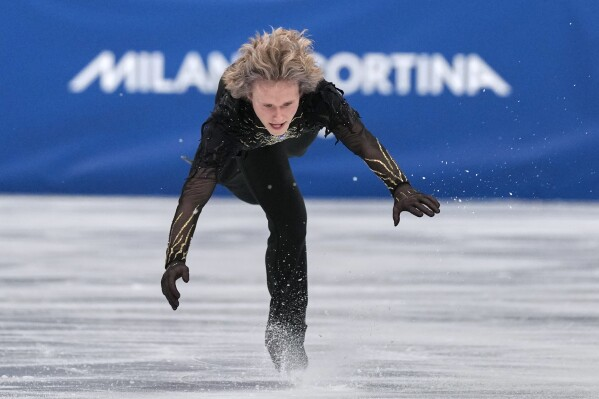
That is the essence of his evolution. Between 2016 and 2026, Malinin didn’t just improve—he redefined improvement itself. He turned difficulty into identity. He transformed risk into routine. And in doing so, he began to reshape what audiences expect when they watch men’s figure skating.
By 2026, standing on the world stage, he is no longer just a competitor—he is a reference point. A standard. His performances are not judged only against others, but against possibility. Each program feels like a quiet negotiation between physics and artistry, where he somehow manages to honor both.
But what truly separates Malinin is not just the jumps. It’s the control. The calmness in chaos. The way he carries immense technical content without losing emotional presence. Many athletes chase perfection—but Malinin seems to chase understanding. And that difference shows in every glide, every landing, every breath between movements.
There is also something deeply human in his journey. Behind the titles, the records, and the global recognition lies a narrative of persistence. A young skater who grew up in the shadows of greatness, who could have followed a safer path—but instead chose to risk everything on the unknown.
And perhaps that is why his story resonates so deeply. Because it isn’t just about skating. It’s about what happens when someone refuses to accept the limits handed to them. It’s about the courage to attempt what hasn’t been done—not once, but repeatedly, until it becomes reality.
From 2016 to 2026, Ilia Malinin didn’t just grow up on the ice.
He changed it.