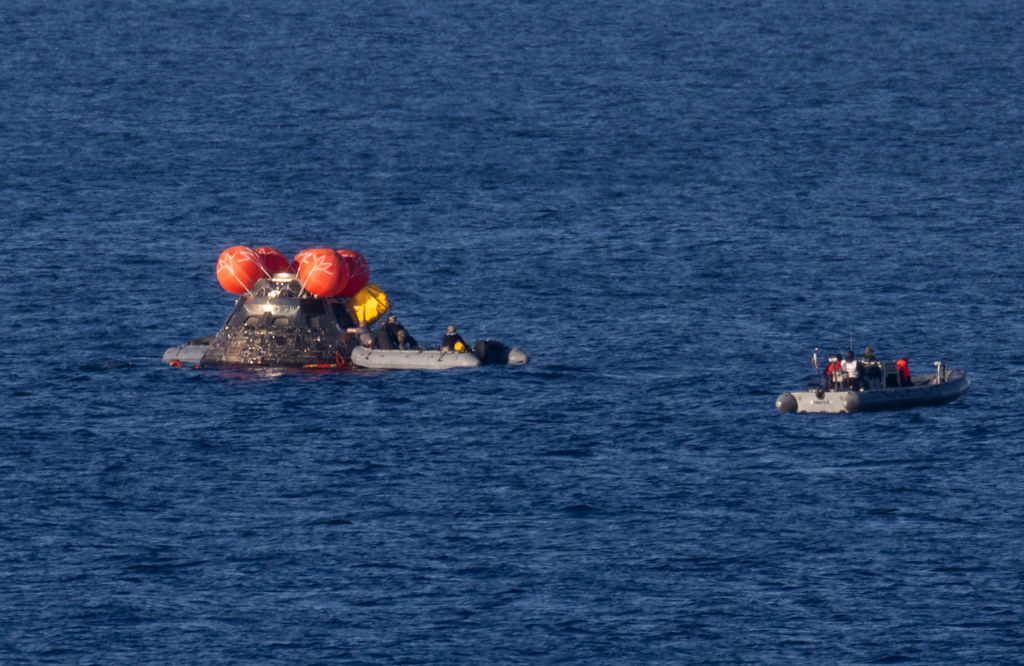
There’s a certain kind of silence that follows something extraordinary—not the absence of sound, but the settling of it. That’s the feeling captured in the image of the Orion spacecraft floating in the Pacific Ocean after its return from the Artemis II. It isn’t dramatic at first glance. It isn’t loud. But if you look closely, it tells a story far more powerful than any launch ever could.
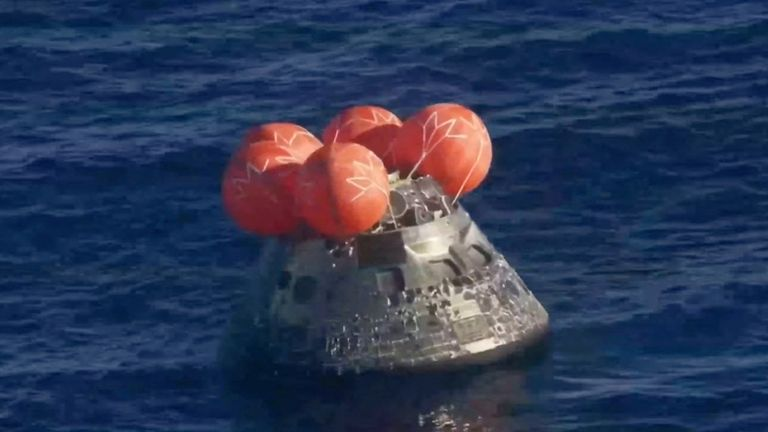
Because this is what survival looks like.
The capsule, still bobbing gently on the surface, carries the visible scars of its journey. Charred heat shield tiles. Scorched thermal blankets. Surfaces darkened by the intensity of reentry. It doesn’t look pristine. It doesn’t look untouched. It looks like something that has been through something—and made it back.
And somehow, that makes it more beautiful.
We often imagine spacecraft as symbols of perfection—clean, polished, engineered to the highest standard. And they are. But what we don’t always see is what happens when that perfection meets reality. When it collides with the raw forces of physics at 25,000 miles per hour. When it absorbs temperatures that would destroy almost anything else.
That’s where the story begins.
Because those marks aren’t damage.
They’re evidence.
Evidence of a journey that pushed the limits of human engineering and human trust. Evidence that something designed on Earth can leave it, travel beyond it, and return through conditions that feel almost impossible—and still hold together.
Still protect.
Still bring people home.
Floating around the capsule are bright flashes of color—yellow and red flotation aids, water-soaked recovery collars that wrap around the spacecraft like a protective embrace. They stand in contrast to the darkened exterior, a reminder that even after surviving the extremes of space, the final steps of the journey still depend on human hands.
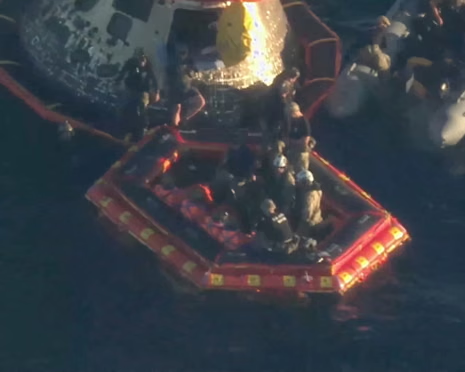
And those hands are already there.
U.S. Navy divers move with precision, preparing to secure the capsule and guide it toward the deck of the USS John P. Murtha. There’s no rush, no chaos—just a calm, practiced rhythm. Because for them, this moment isn’t just recovery.
It’s responsibility.
Inside that capsule, just moments before, were lives entrusted to a machine that had endured everything space could throw at it. And now, as it floats quietly in the ocean, the mission shifts—from survival to return, from distance to home.
What makes this image so powerful isn’t the scale.
It’s the intimacy.
Space exploration is often framed in terms of vastness—millions of miles, infinite darkness, the overwhelming unknown. But here, it feels close. Tangible. Almost personal. You can see the wear. You can imagine the heat. You can feel the weight of what just happened.
And that changes how you see it.
Because suddenly, this isn’t just about a spacecraft.
It’s about resilience.
About what it means to endure something that leaves marks—and to carry those marks not as flaws, but as proof of having made it through. In a way, the Orion capsule becomes a mirror of something deeply human. We don’t come back from our hardest journeys unchanged. We carry the evidence with us.
And that’s what gives those journeys meaning.
The ocean around it is calm, almost indifferent. Waves move as they always have, untouched by the significance of what just occurred. And there’s something poetic in that contrast—the idea that even the most groundbreaking achievements return to a world that continues, steady and unchanged.
But for those who understand what they’re seeing, everything feels different.
Because this moment represents more than the end of a mission. It represents a bridge—between where we’ve been and where we’re going. A reminder that exploration doesn’t end when we reach a destination. It ends when we return, when we bring something back, when we prove that the journey was not only possible, but survivable.
And maybe that’s why this image lingers.
Not because it shows triumph in the way we expect—but because it shows something quieter, something more real. A spacecraft, marked and worn, floating gently after facing the unimaginable.
Still intact.
Still whole.
Still home.