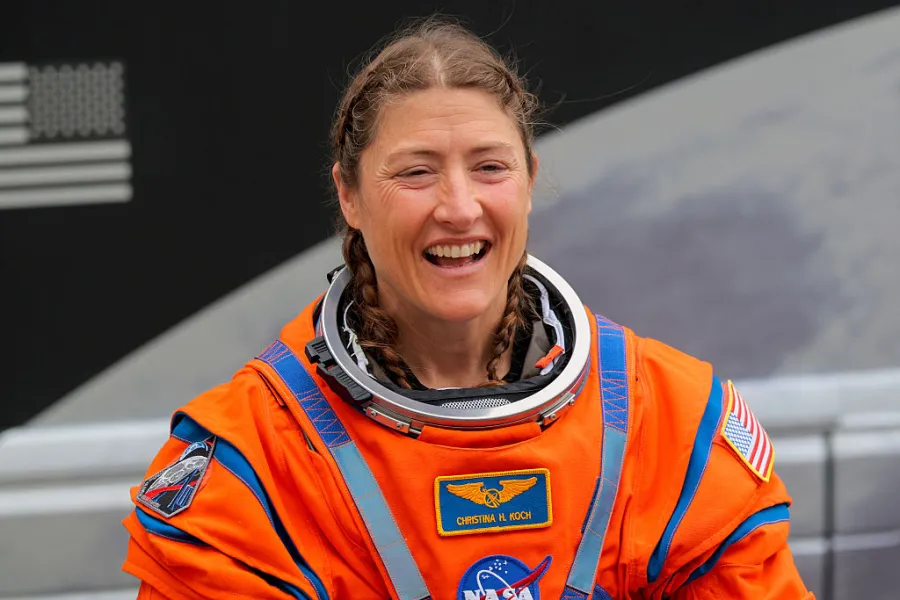
There are homecomings, and then there are moments that feel larger than memory itself. When Christina Koch stood beside a life-sized bronze bust of herself at the North Carolina School of Science and Mathematics, it was more than a ceremony. It was the meeting of past ambition and present achievement — a former student returning not just as an alumna, but as living proof of what possibility can become.
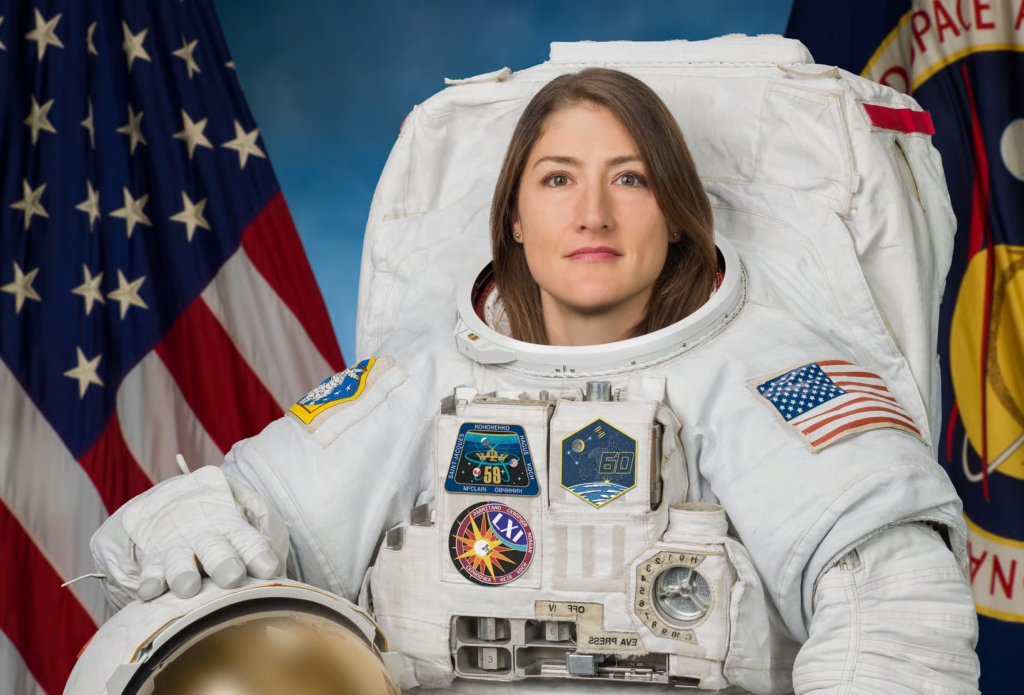
In the Bryan Lobby of the school’s Durham campus, the sculpture now stands as a permanent reminder that greatness does not always begin in famous places. Sometimes it begins in classrooms, in late-night study sessions, in notebooks filled with equations, and in young minds quietly daring to imagine something bigger than their surroundings.
Created by acclaimed artist Wesley Wofford, the bust captures Koch in her flight suit with remarkable detail and quiet strength. Bronze has long been reserved for kings, warriors, thinkers, and icons. To see a scientist and astronaut honored in that same tradition carries its own message. It says discovery deserves monuments too.
The sculpture was gifted to the institution by Wofford and his wife, Odyssey Wofford, as a tribute to the education their two children received there. That gesture transforms the installation into something even more meaningful. It is not only a celebration of one extraordinary graduate, but also a statement about the power of schools to shape futures in ways no one can fully predict.
For students walking through that lobby each day, the symbolism is immediate. They are no longer reading about success in a textbook or hearing it from a distant speaker. They are passing by the likeness of someone who once sat where they sit now, faced exams where they face exams now, and likely carried doubts much like their own.
That matters because inspiration is strongest when it feels reachable.
Christina Koch’s journey is the kind that naturally commands admiration. Her historic 328-day mission aboard the International Space Station placed her among the most accomplished explorers of her era. Life in orbit demands discipline, resilience, technical mastery, and emotional endurance. It is not only a test of science, but of character.
Yet even that milestone was not the final chapter.
Koch was later selected as a mission specialist for Artemis II, a mission carrying humanity’s next bold step toward the Moon. That appointment linked her legacy not only to the history of spaceflight, but to its future. She became part of the bridge between the age of the Apollo Program and the new era of lunar exploration.
And still, in that lobby, what resonates most may not be the titles or records. It may be the humanity of the scene itself: an accomplished astronaut standing beside the bronze version of herself, face to face with the years she once dreamed through.
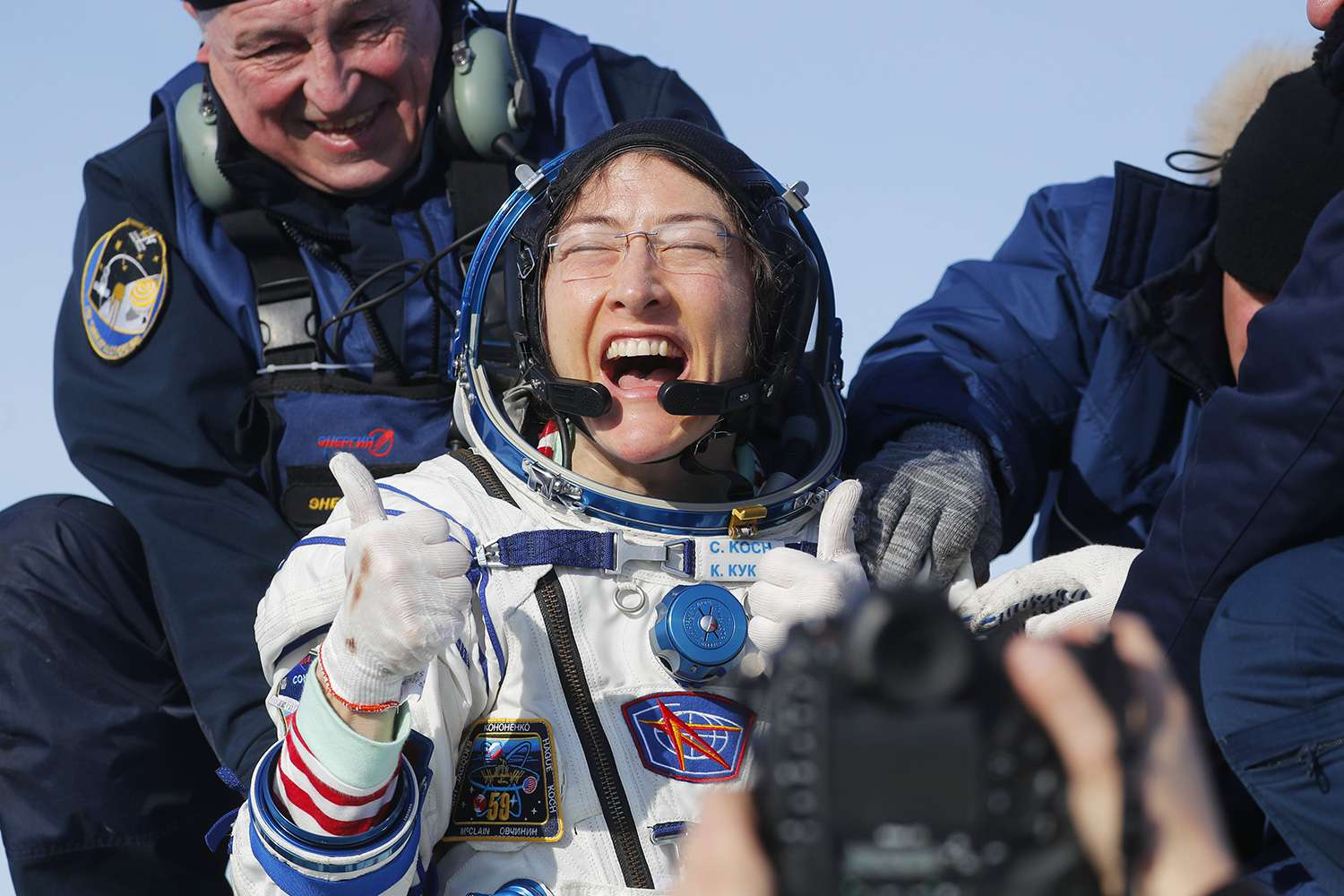
There is something poetic about that image. The living person changes, grows, struggles, succeeds, and continues forward. The bronze figure stands still, capturing one chapter forever. Together, they tell the full story — achievement is never frozen in one moment, but monuments can remind us of what persistence looked like when it mattered most.
Schools often place plaques on walls and names on lists. Those honors are valuable, but a sculpture does something different. It occupies space. It asks to be noticed. It turns inspiration into presence. Students cannot accidentally ignore it. They see it in passing, in stress, in routine, in uncertainty. And perhaps on the day they most need encouragement, they glance up and remember that someone from these halls once touched the stars.
For young women interested in science, engineering, aviation, mathematics, or leadership, the symbolism deepens further. Representation changes imagination. When students see someone who resembles them honored for intellect, courage, and achievement, invisible barriers begin to weaken. Futures once considered rare begin to feel real.
That may be the greatest purpose of the monument.
Not to celebrate the past alone, but to provoke the future.
Somewhere in that school today, a student may be struggling through calculus, wondering if they are capable enough. Another may feel intimidated in a laboratory. Another may quietly dream of rockets, medicine, robotics, or planetary science while doubting whether dreams like that belong to people like them.
Then they pass the bronze bust.
They see a graduate from 1997 who once started exactly where they are now.
They see proof that extraordinary destinations can emerge from ordinary beginnings.
And maybe, without saying a word, the statue gives them something no classroom lesson can fully teach: permission to aim higher than they thought possible.
Because sometimes the most powerful monuments are not built to honor the person they depict.
They are built for the people still becoming who they might be.