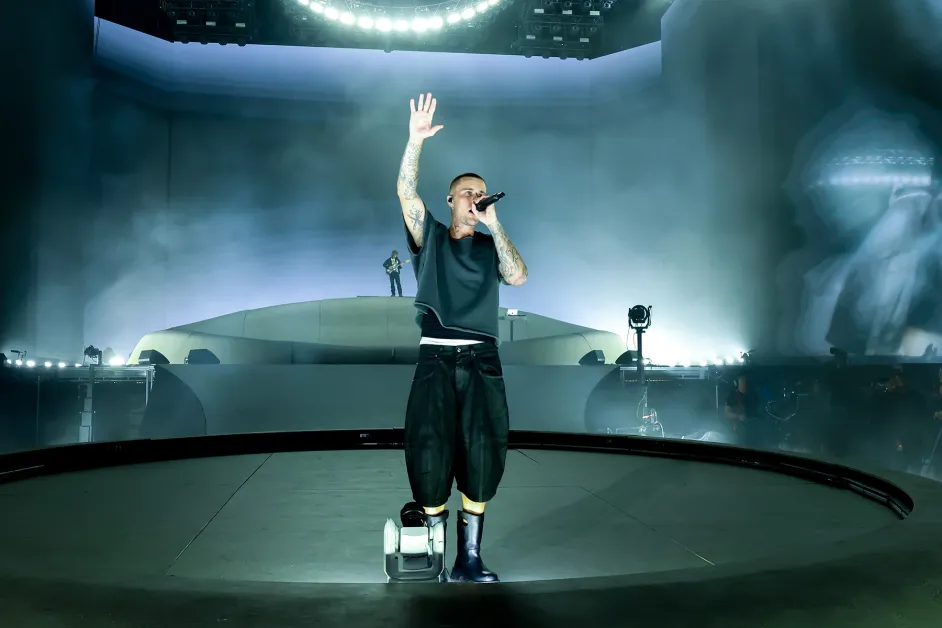
There are comebacks that feel like fireworks—and then there are the ones that arrive like a question mark. When Justin Bieber stepped onto the stage at Coachella, the expectation wasn’t subtle. It was loud, collective, almost cinematic. Fans didn’t just want a performance—they wanted a moment that justified the wait.
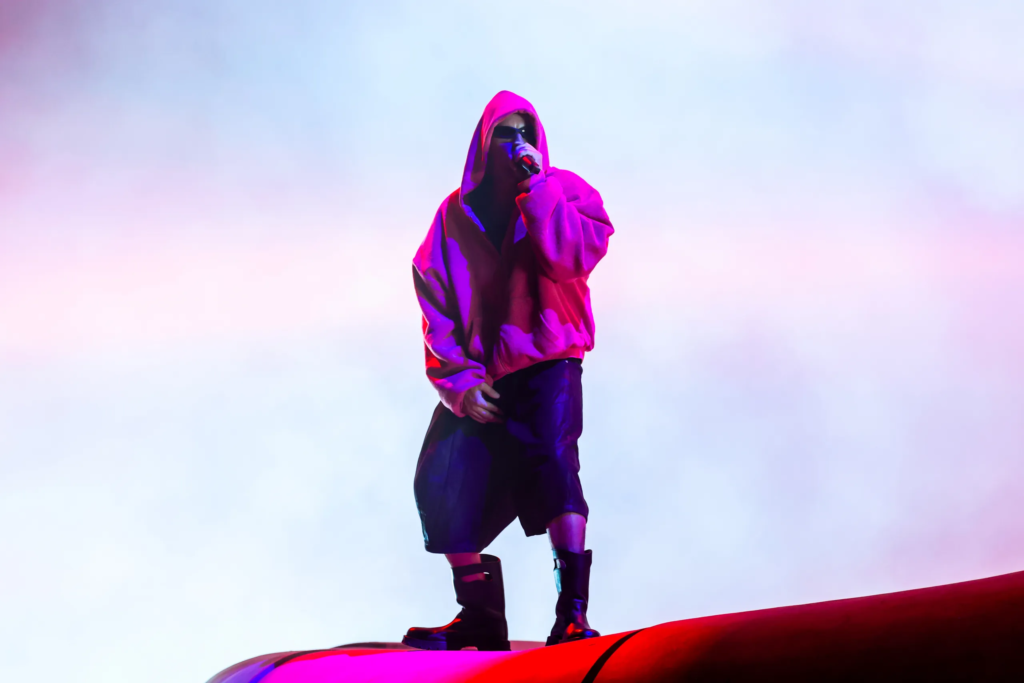
Instead, what they got felt… unfamiliar.
No dramatic entrance. No explosive opening. Just Bieber, walking out in a hoodie and shorts, carrying none of the spectacle typically associated with a headline set of that scale. For an artist whose presence once defined pop grandeur, the simplicity wasn’t just noticeable—it was jarring.
At first, the crowd leaned in, curious.
But as the set unfolded, that curiosity began to shift.
The biggest hits—the songs that built arenas, defined eras, and echoed across years—didn’t arrive in the way fans expected. Instead of hearing them live, pieces of those tracks played from a laptop, streamed through YouTube, while Bieber moved through a setlist that leaned heavily on deeper cuts and lesser-known material.
And that’s when the confusion settled in.
Because this wasn’t just a creative choice—it felt like a statement. Whether intentional or not, the performance drew a line between what audiences anticipated and what the artist chose to deliver. And in that gap, reactions began to fracture.
Some called it bold.
Others called it baffling.
On one side, there were fans who saw something experimental in the restraint. A rejection of overproduction. A refusal to recreate the past just to satisfy nostalgia. In a festival environment built on spectacle, Bieber’s stripped-back approach felt almost rebellious—like he was quietly asking whether presence alone could still hold a crowd.
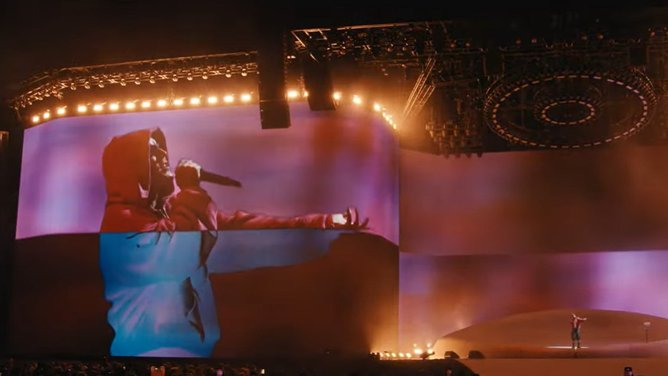
But on the other side, there was disappointment that couldn’t be ignored.
Because for many, this wasn’t just another set—it was a comeback. A moment that carried emotional investment, anticipation, and a kind of unspoken promise. And when that promise didn’t unfold in familiar ways, it left people searching for meaning in the absence of what they expected.
Was it intentional distance?
Was it artistic reinvention?
Or was it something else entirely—something quieter, less defined, and harder to explain?
What made the moment even more complex was the scale surrounding it. Reports of a multi-million-dollar performance only amplified the contrast between expectation and execution. The bigger the stage, the louder the silence when something feels off.
And yet, there was something undeniably compelling about it.
Not in the way traditional performances captivate—but in the way unresolved moments linger. The kind that spark debate, invite interpretation, and refuse to settle into a single narrative. Because even those who walked away confused couldn’t quite look away from what had happened.
That’s the paradox of it.
This wasn’t a performance that united people.
It divided them.
But in doing so, it achieved something unexpected—it became one of the most talked-about moments of the festival. Not because it was perfect, but because it was unpredictable. Not because it delivered, but because it disrupted.
And maybe that’s where the real story lives.
Because artists don’t just perform songs—they navigate expectations. They carry past versions of themselves onto stages that demand evolution, while audiences hold onto memories that resist change. Somewhere between those two forces, something has to give.
At Coachella, it did.
What Bieber presented wasn’t the comeback many had imagined. It wasn’t the polished, hit-driven spectacle that would have been easy to celebrate. Instead, it felt like a fragment of something unfinished—an artist standing in the space between who he was and who he might be next.
And that space is uncomfortable.
But it’s also honest.
Because sometimes, the most revealing performances aren’t the ones that prove something—they’re the ones that leave us questioning everything.