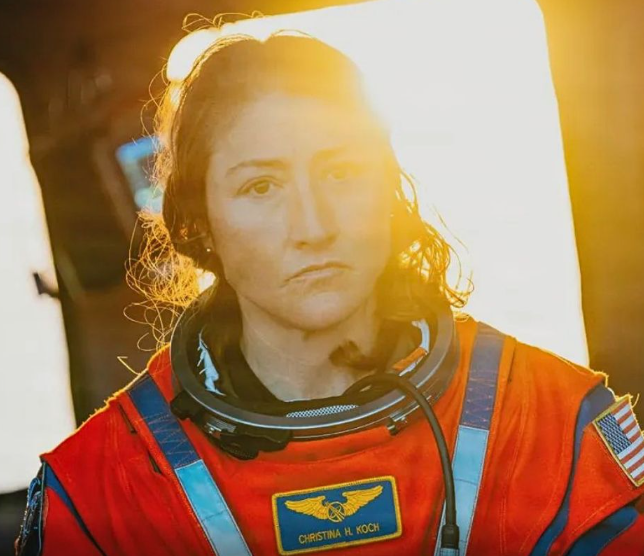
Some photographs do more than capture a person—they capture a turning point in history. The image of Christina Koch standing shortly after the return of Artemis II feels exactly like that. Her expression, steady yet visibly marked by the weight of the journey, tells a story no mission timeline ever could. It is the face of someone who traveled beyond the familiar, saw humanity from a distance, and came home carrying something words struggle to hold.
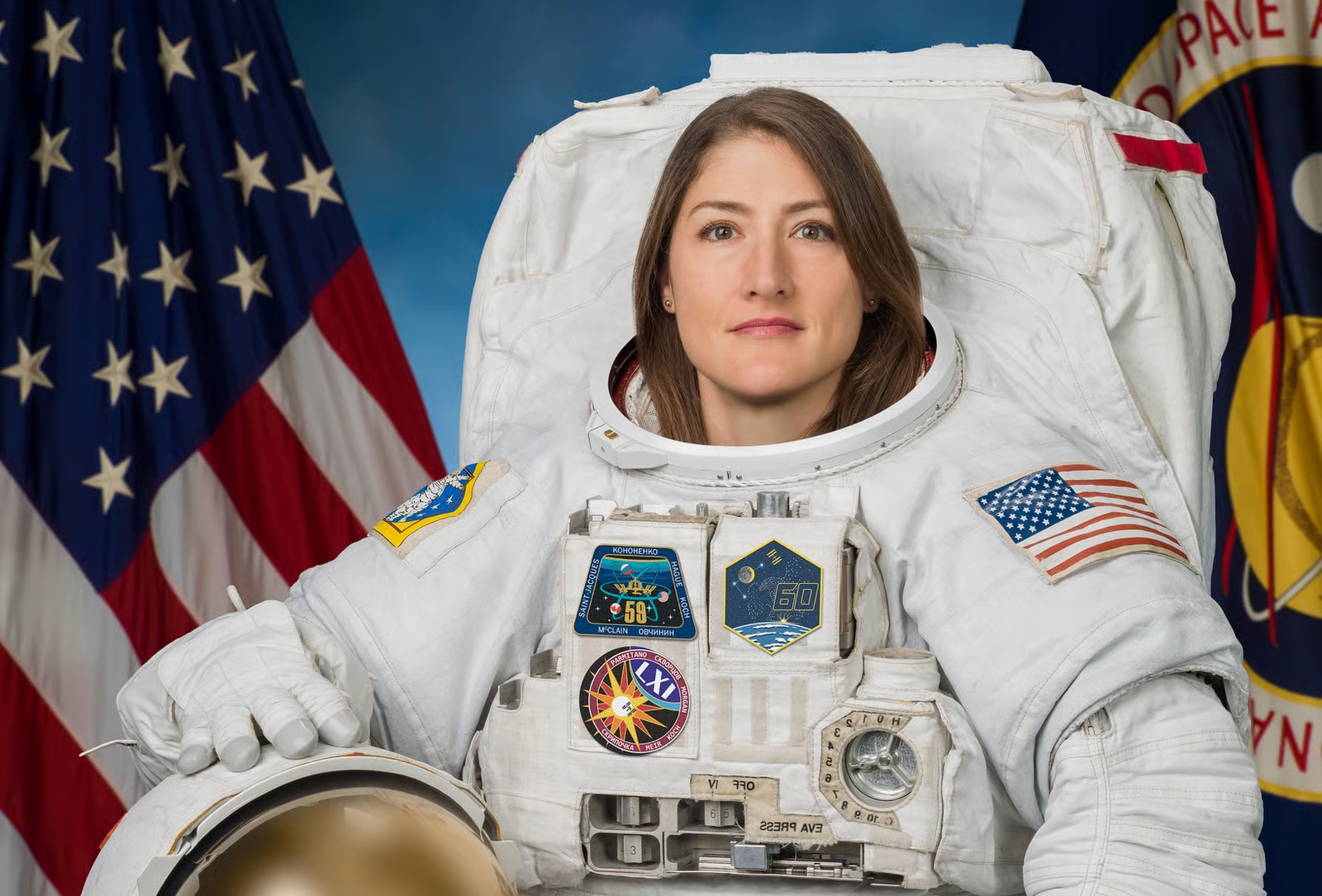
On April 10, 2026, Artemis II concluded with a successful splashdown in the Pacific Ocean after a historic crewed journey around the Moon—the first human mission to lunar vicinity in more than 50 years. The crew of four returned not just as astronauts, but as symbols of a new chapter in exploration. Their safe arrival marked the successful test of systems that future missions will rely upon.
For Koch, the moment carried additional significance. She became the first woman to travel beyond low Earth orbit and into the lunar mission era, a milestone that resonates far beyond aerospace headlines. Representation in exploration matters because space has always reflected the ambitions of Earth. When new faces reach old frontiers, history expands.
Yet what makes this portrait powerful is not only symbolism. It is humanity. Space travel places enormous strain on the body—re-entry forces, isolation, disrupted rhythms, confined living, and the mental intensity of operating in an unforgiving environment. After ten days in deep space, a person does not simply step out unchanged. They return carrying fatigue, awe, and perspective.
Clad in the Orion Crew Survival System suit, Koch stands as proof that the engineering worked. Suits, life-support systems, navigation software, communications networks, heat shielding, recovery operations—thousands of people’s work converged into one simple outcome: the crew came home safely. In exploration, success is often measured in ordinary miracles like breathable air, accurate burns, and a capsule opening after splashdown.
That is the hidden beauty of missions like Artemis II. To the public, it can look like a grand spectacle of rockets and headlines. Behind the scenes, it is a symphony of precision. Every valve, sensor, trajectory adjustment, and checklist matters. The returning astronaut becomes the visible tip of an invisible mountain of effort.
But perhaps the greatest thing Koch brought back was perspective. Astronauts often describe seeing Earth from afar as emotionally transformative. Borders vanish. Conflicts look smaller. Fragility becomes obvious. The planet appears less like territory and more like shared shelter. Koch herself reflected on Earth as a “lifeboat” in the vast darkness of space.
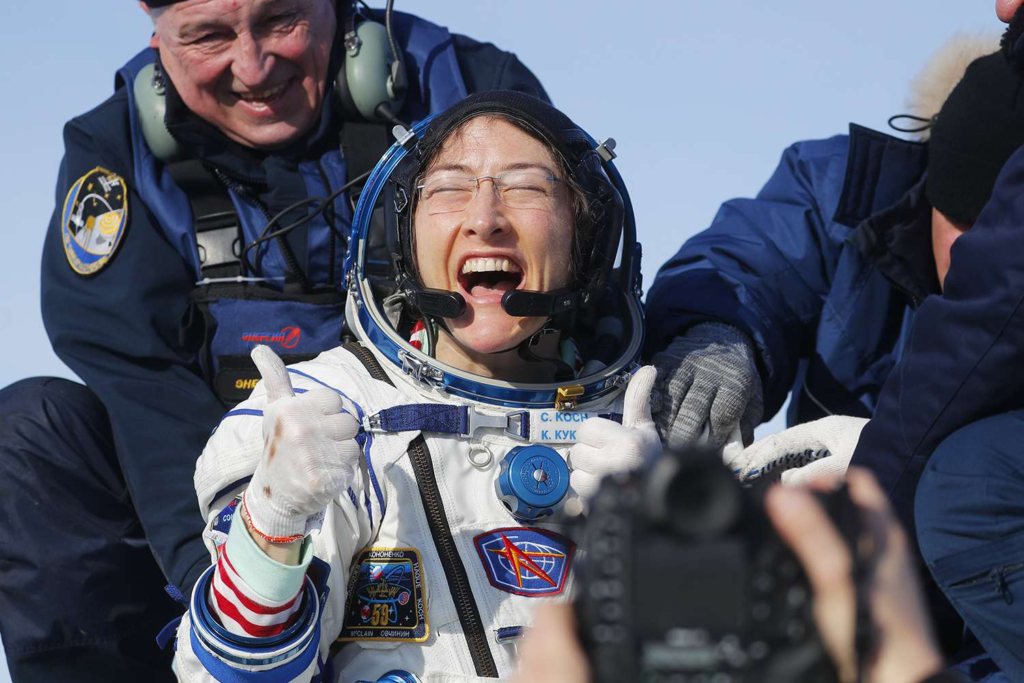
That is why her portrait resonates so deeply. It is not merely about endurance. It is about witness. She has seen something most humans never will—the curve of home hanging in silence, the Moon up close, the distance between our daily worries and the larger universe. When such a person looks into a camera, people sense that they are looking at someone who has returned with altered vision.
Artemis II was also a bridge mission. It validated crew operations and spacecraft systems ahead of what comes next. Artemis III is expected to pursue the next human landing on the Moon, while Artemis IV is planned to expand lunar operations and support longer-term presence. Artemis II was the proving ground that makes those ambitions credible.
In many ways, exploration always depends on transitional missions more than famous ones. The world remembers first steps on the surface, but those steps only happen because earlier crews test the unknown, absorb the risk, and gather the data. Artemis II may not be the mission that plants the next bootprint, but it may be remembered as the mission that made it possible.
And then there is the emotional dimension of return itself.
Every launch is dramatic, but every safe landing is sacred. Families wait. Colleagues hold breath. Entire control rooms remain locked in concentration until parachutes bloom and recovery teams confirm the crew is secure. When the hatch opens, relief floods through thousands of people at once.
So when Christina Koch stood there after splashdown, she represented more than personal achievement. She represented preparation rewarded, courage fulfilled, and the stubborn human instinct to go farther while still finding our way back.
That is why this portrait matters.
It is not just an astronaut after a mission.
It is humanity catching its breath at the edge of a new era.